There were 4 vessels in the Fleet:-
|
Built
|
Length
|
Width
|
Tonnage
|
Engines
|
Passengers/Cars
|
| Robert The Bruce |
1934 |
149 ft |
28 ft |
228 |
Paxman |
500/28 |
| Queen Margaret |
1934 |
148 ft |
28 ft |
228 |
Paxman |
500/28 |
| Mary Queen of Scots |
1949 |
150 ft |
28 ft |
230 |
Crossley Bros Ltd |
500/35 |
| Sir William Wallace |
1956 |
161.5 ft |
30 ft |
277 |
Crossley Bros Ltd |
500/40 |
|
The Robert The Bruce was the first all welded vessel as well as the first with diesel-electric paddles. Details of the Paxman engines used on the Robert The Bruce & Queen Margaret have kindly been supplied by Richard Carr.
All the ferries were built by William Denny & Brothers Ltd who also operated the Queensferry Passage.
Maurice Denny championed the expansion of the ferry service in the 1930s, providing and operating two additional ferries on behalf of the London and North Eastern Railway that aimed to supplement the services of the adjacent railway bridge. Their success allowed for the addition of two more craft in the 1940s and 1950s.
The ferries only had a draught of approximately 4 ft 6 inches which made them difficult to manoeuvre in high winds. Newspaper articles record how the ferries on occasions ran aground during gales. The number of times this occurred however was relatively few.
Their service speed was 8 knots and the 6 crew consisted of a Captain, Mate, Engineer, Ticket Clerk and two Deckhands.
Despite high winds, sea fog and the occasional breakdown the ferries ran at a 99.97% efficiency.
The ferries were making 40,000 trips a year and carrying 900,000 vehicles. The Forth Road Bridge which replaced the ferries had 4 Million crossings in its first year and currently has 24 Million crossings. Construction of a further bridge across the Forth is currently underway. |
This web site mainly deals with the 4 ferries that were built by Denny's between 1934-1955, however there was another ferry the Dundee which operated between 1917 and 1949. This ferryboat operated as a relief vessel from 1934 after the arrival of the Bruce and the Margaret. It finished in 1949 when the Mary arrived and she was scrapped in 1951. While operating on the Queensferry Passage she was leased to Wm Denny & Bros. Ltd.
| Dundee:- |
|
| Launched 22/05/1875 by ship builders William Simons & Co. Ltd., Renfrew (yard no. 187) |
Gross Tonnage 264
Lenght 149.3ft
Beam 27.1ft |
Engine Builders - William Simons & Co. Ltd., Renfrew - Compound diagonal 2cyl. (23 & 42 x 42"), 80nhp - Paddle wheel. |
Details of three ships have been traced in the Lloyds Register.
|
The information booklet shows the Sailing Times together with Charges and makes interesting reading. Charges were very detailed, the vehicles rate is based on the size of the engine or Horse Power. There was also charges for Horses, but Stallions were nearly 4 times more expensive to transport. Lorries were based on weight and a separate charge is noted for Hearses, extra being charged if carrying a corpse.
Juvenile & Adult tickets can be viewed together with a ticket for vehicles, note the date on the ticket 03-September-1964, the day before the ferries stopped running. It must have been one of the last tickets printed.
|
A schedule is also held showing the timings of the summer (1964) sailings, it details how the sailings would be adjusted if one of the vessels required repair or if there was fog. The names of the captains are listed, which includes Captain Tom Penny, brother of Captain John Penny.
A document dated 02-April-1956 can be viewed showing the 8 crews that operated the 4 vessels and their shift rota. Details of Rates of Pay and Conditions of Service in 1956 are contained in a further document. It includes details of the issue of uniforms and working hours etc. The uniform jacket worn by the Captains can be viewed.
The Captains were invited to an annual dinner at the Hawes Inn at South Queensferry, the invitations for 1959 & 1960 can also be be viewed.
|
The ferries last carried passengers on 04-September-1964. A revised time table & protocols had to be followed on that day. The closure of the Queensferry Passage and the opening of the Forth Road Bridge was a huge occasion for the men who worked on the ferries. To ensure their families were given an opportunity to view the formalities, passes were issued, a copy of the pass is also displayed.
The fate of each of the ferries was as follows:-
| |
Robert The Bruce |
Scrapped at P & W McLellan at Boness in 1965. |
| |
Mary Queen of Scots |
Scrapped at T W Ward at Inverkeithing in 1965. |
| |
Queen Margaret |
Scrapped at T W Ward at Inverkeithing in 1965. |
| |
Sir William Wallace |
Scrapped 1970 in Ghent after carrying cargo on the river Ljsselmeer. |

To celebrate the opening of the new road bridge First Day Covers were produced. Two on display were written by Captain John Penny to his son. Other first day covers are on display, each with an interesting history, these were kindly supplied by Kerr Doig. |
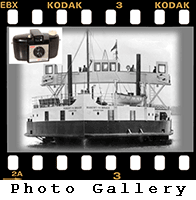
There are 5 galleries attached to this site, one contains a selection of photographs of the ferries and their crew .

(Any visitor to this site that has photographs of the ferries that could be used on this site please contact me using the e mail link below.).jpg)
The second contains photographs of two superb models of the Sir William Wallace which were built by Eddy Matthews, the models are to a scale of 1:43 & 1:32.
The third contains links to videos of the ferries.
The fourth relates to the feature film "The 39 Steps". The film is based on the John Buchan novel and has footage of the ferries. This excellent thriller staring Kenneth More was made in 1959 and has a sequence where the main character Hannay jumps from a train onto the Forth Bridge and escapes. In the background the ferries can be seen below the bridge, which ferries are in the film is difficult to tell, all 4 would be in service by then, I would guess they are either the Bruce or the Margaret.
There is also a separate gallery containing extracts from the brochure produced by Denny's of Dumbarton, these were produced in relation to the years 1951 - 1955 & 1956 - 1960.
|
Spot The Difference?
The four vessels are very similar, if the names on the hull are not visible how can each be identified? The photographs opposite help but reference to the images in the Gallery section of this site will make identification easier. The clues to look out for are the last two ferries built have diagonal steps running from the paddle housing to the wheel house. The earlier vessels have vertical steps. The Sir William Wallace and the Mary Queen of Scots can then be identified as the Wallace is larger, this results in a longer gap between the paddle housing and the ramp.
I have yet to determine how the two earlier vessels, the Margaret & Bruce can be identified individually, perhaps as more photographs are unearthed it will become obvious. Of course if any visitor to this site knows how this can be achieved then please contact me via the e-mail link below.

The Sir William Wallace Flag which is approximately 12 feet long.
|
You will also find displayed a map, although this 1896 map is strictly not connected with the ferries covered by this web site, but it may be of interest to some as it relates to North Queensferry. Maps are also included which show where the Queensferry Passage operated.
There is also a copies of Newspaper articles which plot the history of the ferries, articles from 1939 to 1955 are reproduced, these having been discovered with the help of "Google News".
The following certificates can also be viewed:-
| Passenger Certificate |
The Sir William Wallace was the newest and largest of the 4 ferries which operated on this route. Her Passenger Certificate shows the 277 tonnage vessel was authorised to carry 500 passengers and 6 crew. |
| Pilotage Certificate |
The Captains required a Pilotage Certificate to allow them to be the Master of each of the ferries. |
| Compass |
The ships compasses were tested for accuracy as can be seen by this certificate. |
| Lifeboats |
The Passenger Certificate shows the Wallace was a "Class V" vessel and as such the lifeboats had to carry specific equipment which is detailed. A 1954 certificate in connection with Launching the Lifeboat is also shown. |
|
|